


Introduction
Anti-Müllerian hormone (AMH), a dimeric glycoprotein belonging to the transforming growth factor-beta family, is secreted by granulosa cells with preantral and early antral follicles [1]. AMH is a better marker than age, follicle-stimulating hormone (FSH) levels on day 3, estradiol (E2) levels or inhibin levels in predicting ovarian response to controlled ovarian stimulation (COS) prior to in vitro fertilization (IVF) and intracytoplasmic sperm injection (ICSI). The predictive value of AMH is known to be similar to that of the antral follicle count [2,3,4].
van Rooij et al. [5] reported that AMH levels correlate with the age-related decline in reproductive capacity. AMH levels are the especially valuable prognostic factor for pregnancy in women over 40 years of age who show a good response to COS [6]. Hence, AMH levels in women over 40 years of age can be hypothesized to be a predictive factor for pregnancy after IVF/ICSI cycles. However, according to a recently published meta-analysis, AMH levels were positively correlated with live birth after assisted reproduction techniques, but showed poor prognostic accuracy [7].
The goal of this retrospective study was to determine the predictive value of AMH levels for pregnancy outcomes by investigating the clinical pregnancy rate (CPR) according to AMH levels in patients over 40 years of age who underwent IVF/ICSI cycles.
Methods
1. Patients
The medical records of women aged 40 to 44 years who underwent IVF/ICSI treatment from January 1, 2013 to September 1, 2014 in the fertility center of CHA Gangnam Medical Center were analyzed. The inclusion criteria were (1) a diagnosis of unexplained infertility without any other infertility-related diagnoses and (2) the performance of actual embryo transfer (ET). Cases in which the retrieval of oocytes failed and cases where no embryos were adequate for ET were excluded. The other exclusion criteria were male factor infertility as indicated by factors such as oligozoospermia and azoospermia in semen analysis; an abnormal uterine cavity on hysterosalpingography; and transvaginal sonographic findings with visible hydrosalpinx or endometrioma. A gonadotrophin-releasing hormone (GnRH) antagonist protocol with recombinant FSH (GONAL-f, Merck Serono, Darmstadt, Germany), Cetrotide (Merck Serono), and Ovidrel (Merck Serono) was used. No additional treatments or supplements such as dehydroepiandrosterone or growth hormone were used. Only cases with IVF/ICSI-fresh ET cycles were included in our analysis, and thawed ET cycles were excluded. This study was approved by the Institutional Review Board of our institution. We retrospectively analyzed the medical records of the patients who were enrolled in our study.
When the IVF-ET cycle using a GnRH antagonist regimen started, serum FSH and AMH levels were measured on the second and third days of menstrual cycle. The Beckman-Coulter second-generation AMH assay was used to estimate AMH levels [8].
2. GnRH antagonist protocol
Ovarian stimulation was initiated on the third day of the menstrual cycle with 150 to 300 IU of recombinant FSH. Ovarian response monitoring was performed using serial vaginal ultrasonography. When dominant follicles reached 14 mm in mean diameter, 0.25 mg/day of a GnRH antagonist (Cetrotide, Merck Serono) was initiated and was continued until the day of recombinant human chorionic gonadotropin (r-hCG) injection. When at least two follicles with a mean diameter of 17 mm were observed, 250 µg of r-hCG (Ovidrel, Merck Serono) was injected subcutaneously. Serum E2 levels were measured on the day of r-hCG injections. Oocyte retrieval was performed 34 to 36 hours after r-hCG injection using a 17-gauge needle under transvaginal ultrasonography guidance. Conventional IVF or ICSI was performed according to previously published protocols. A maximum of three embryos were transferred. The luteal phase was supported by daily vaginal administration of 90 mg of progesterone (Crinone gel, Merck Serono) after oocyte retrieval.
3. Data collection and analysis
Several patient characteristics were analyzed in this study. The continuous variables included age, body mass index (BMI), infertility duration, the number of IVF treatments, serum FSH and AMH levels on days two and three of the menstrual cycle, serum E2 levels on the r-hCG trigger day, the number of retrieved oocytes, and the number of oocytes in metaphase II (MII). Categorical data included history of previous ovarian surgery, CPR, and high-quality ET. Patients were divided into group A (AMH levels <1.0 ng/mL) and group B (AMH levels ≥1.0 ng/mL), based on the criteria established by Nardo et al. [11], and the data from both groups were compared and analyzed.
4. Statistical analysis
The data were analyzed using PASW ver. 18 (SPSS Inc., Chicago, IL, USA). Continuous variables were presented as mean±standard deviation and were evaluated for statistical significance using the Student's t-test or the Mann-Whitney U test. Categorical data were expressed as number (percent) and were compared using the chisquare test. Logistic regression analysis was performed to determine the effect of individual variables on the CPR. The p-values <0.05 were considered to indicate statistical significance.
Results
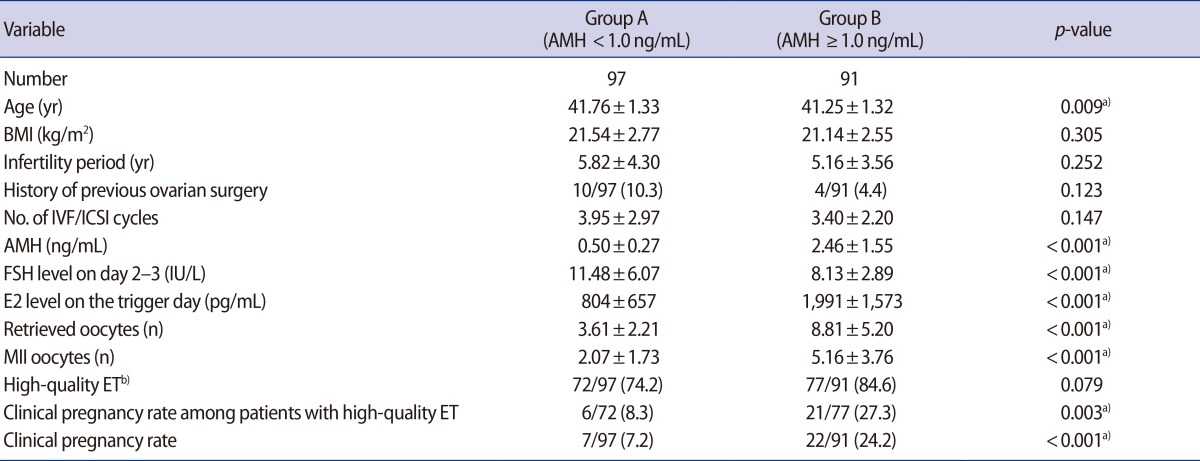
A total of 188 patients who underwent IVF/ICSI-fresh ET cycles were analyzed. Group A included 97 patients with AMH levels <1.0 ng/mL, while group B included 91 patients with AMH levels ≥1.0 ng/mL. The patients in group B were on average 0.51 years younger than those in group A (p=0.009). No significant differences were found between the two groups in BMI, infertility duration, the number of IVF treatments, and history of previous ovarian surgery (Table 1). However, a significant difference was found between both groups with regard to FSH levels on days 2 and 3 of the menstrual cycle and E2 levels on the r-hCG trigger day (p<0.001) (Table 1).
A significant difference was found between group A and group B in the number of retrieved oocytes (3.61±2.21 vs. 8.81±5.20, p<0.001) and the number of oocytes at MII (2.07±1.73 vs. 5.16±3.76, p<0.001). A marginally significant difference between groups A and B was found with regard to the frequency of at least one instance of high-quality ET (72/97 [74.2%] vs. 77/91 [84.6%], p=0.079). The CPR was significantly lower in group A than in group B (7/97 [7.2%] vs. 22/91 [24.2%], p<0.001). The frequency of clinical pregnancy in patients with high-quality ET was significantly lower in group A than in group B (6/72 [8.3%] vs. 21/77 [27.3%], p=0.003).
Our study found significant differences in AMH levels between pregnant patients (n=29) and non-pregnant patients (n=159) (2.51±2.02 ng/mL vs. 1.26±1.26 ng/mL, p<0.001) and in FSH levels on days two and three of the menstrual cycle (7.99±3.15 IU/L vs. 10.20±5.29 IU/L, p=0.038). In addition, a significant difference was found in the prevalence of high-quality ET between pregnant patients and non-pregnant patients (28/29 [96.6%] vs. 122/159 [76.7%], p=0.015), which suggests that AMH levels may be associated with embryo quality in infertility patients over 40 years of age (Table 2).
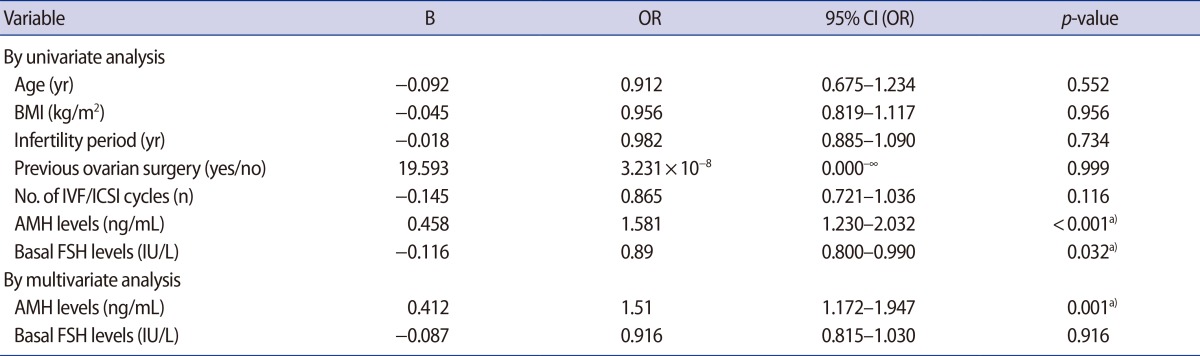
Logistic regression tests found that age did not have a significant effect on the CPR (odds ratio [OR], 0.912; 95% confidence interval [CI], 0.675–1.234; p=0.552, by univariate analysis). In univariate analysis, AMH (OR, 1.581; 95% CI, 1.230–2.032; p<0.001), and FSH levels (OR, 0.890; 95% CI, 0.800–0.990; p=0.032) had a significant impact on the CPR; whereas, in multivariate analysis, AMH levels were the only factor found to have a significant impact on the CPR (OR, 1.510; 95% CI, 1.172–1.947; p=0.001) (Table 3).
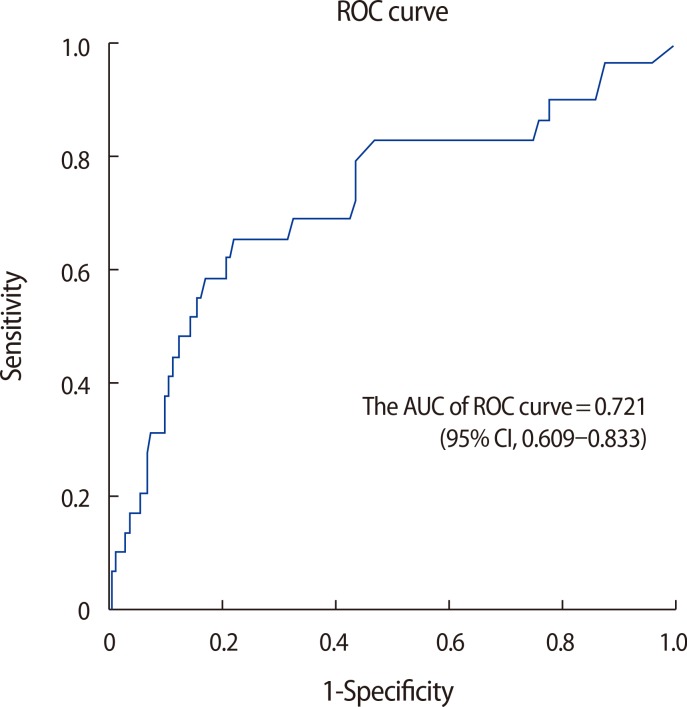
The area under the curve (AUC) value of the receiver operating characteristic curve for AMH levels as a predictor of clinical pregnancy was 0.721, which was indicative of a fair predictive model (Figure 1). When an AMH level of 1.90 ng/mL was set as the cut-off point, the CPR was 6.731-fold higher in the group with AMH ≥1.90 ng/mL than in the group with AMH <1.90 ng/mL (19/54 [35.2%] vs. 10/134 [7.5%]; OR, 6.731; 95% CI, 2.867–15.791; p<0.001).
Discussion
Serum AMH levels may be a potential predictor of ovarian response in COS, pregnancy outcomes, and live birth, although these associations remain controversial [12,13,14]. In particular, serum AMH levels are known to be the best indicator of ovarian reserves [2,11,15]. Since previous studies were not able to predict the outcomes of IVF/ICSI-ET cycles accurately due to the high level of variability in fertility between individuals according to age [16,17,18,19,20,21], it may be meaningful that setting an appropriate cut-off value of serum AMH levels in infertile women over 40 years of age could allow an individualized approach to treatment by stratifying the patients according to prognosis.
Age is the primary determinant of pregnancy outcomes in IVF/ICSI cycles [22,23]. However, the relationship between the chronological age of women and their reproductive capacity is very complex [24]. Roest et al. [6] reported that patients over 40 years of age who showed a good response to ovarian stimulation had better outcomes in pregnancy. In our study, significant differences in the number of retrieved oocytes at MII and the CPR were observed in patients aged over 40 years between those with AMH levels ≥1.0 ng/mL and those with AMH levels <1.0 ng/mL. Moreover, the CPR was significantly higher in patients who underwent high-quality ET (Table 1). The CPR was 6.731-fold higher in patients with AMH levels ≥1.90 ng/mL (35.2%, 19/54) than in patients with AMH levels <1.90 ng/mL (7.5%, 10/134), which was found to be a significant difference.
Positive correlations between serum AMH levels and embryo quality, fertilization rates, and pregnancy rates have been reported [12,13,25,26]. Some studies have found AMH levels to be a poor predictor of pregnancy and live birth [20,21]. However, the current study demonstrated that AMH levels in patients over 40 years of age are a valuable predictive tool for pregnancy outcomes (Figure 1). Twisk et al. [27] reported that even morphologically normal embryos can have abnormal chromosomes, resulting in a low pregnancy rate. We found a significant difference in the CPR of patients with high-quality ET based on AMH levels. Hence, high AMH levels can function as a predictor of the embryo quality in patients over 40 years of age.
The limitations of this study were as follows. First, this was a retrospective study, meaning that it was not possible to control for all confounding factors that could have impacted the clinical outcomes. However, the study was strengthened by the consistent application of a unified IVF/ICSI protocol with GnRH antagonist cycles. Second, the basal characteristics indicated that the patients with AMH levels <1.0 ng/mL were 0.51 years older on average than the patients with AMH levels ≥1.0 ng/mL, which was a statistically significant difference (Table 1). However, since age was not found to have a significant effect on the CPR by logistic regression analysis, it should not be considered to have had a major influence on the study results, despite the slight difference in age between the two groups.
In conclusion, our study found AMH levels to be predictive of clinical pregnancy in infertility patients over 40 years of age. Furthermore, we determined the AUC value and the optimal cut-off value of AMH levels for predicting pregnancy. However, our study had the limitation of being a retrospective study. Thus, a well-designed prospective study should be conducted to validate the predictive capability of AMH levels.



 PDF Links
 PubReader
 XML Download
 Full text via DOI
 Full text via PMC
 Download Citation